
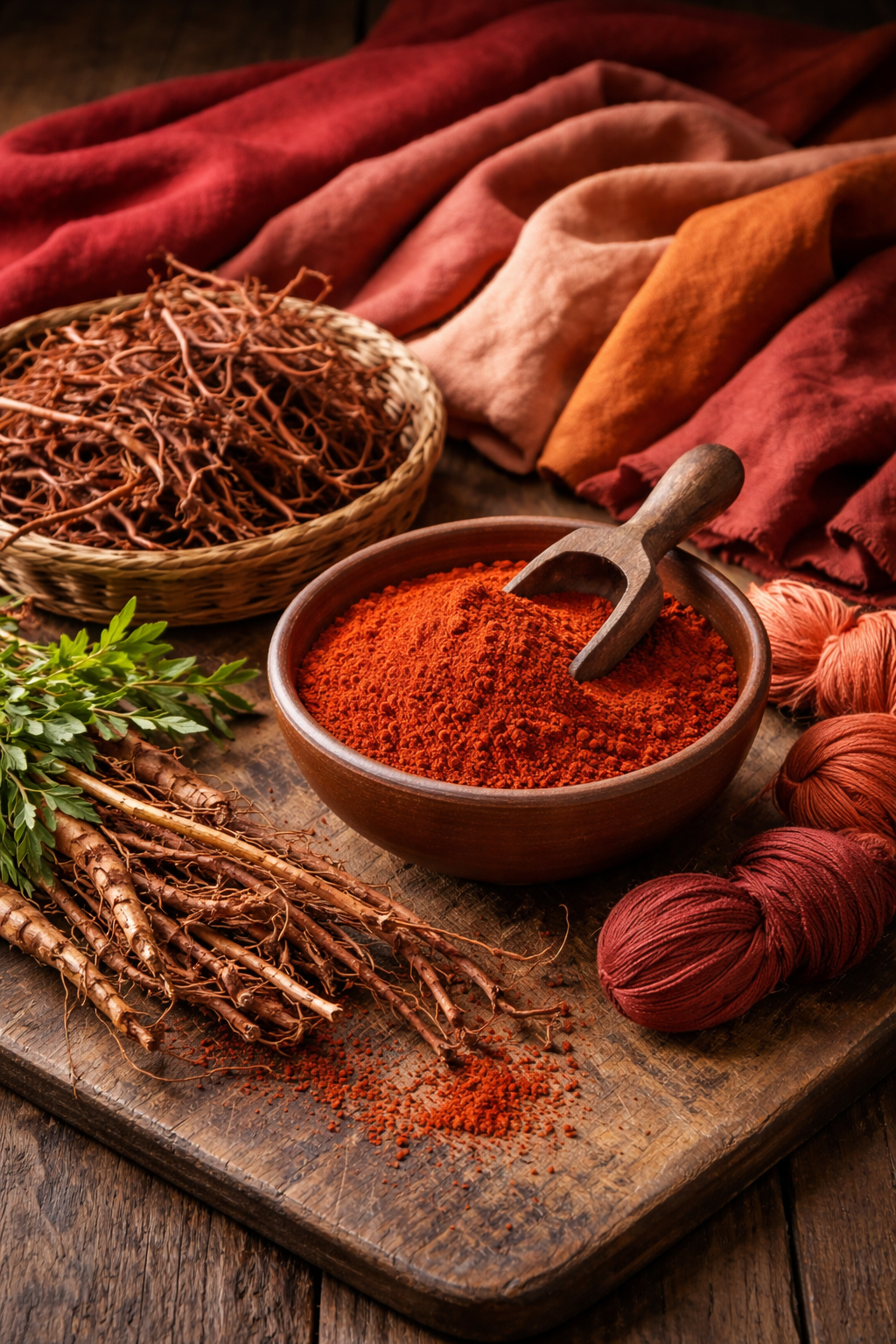
Madder Extract (Rubia cordifolia)
Madder is one of the oldest and most widely used traditional dyestuffs known to humankind, with a rich history spanning thousands of years. Its use is deeply rooted in Turkey, India, and Iran, where madder continues to be used today in the dyeing of knotted and woven carpets. The legendary Turkey Red—a deep, luminous red—was so prized that its process was guarded for centuries across Central Asia. Achieving this color traditionally required more than twenty carefully controlled steps, making it one of the most complex natural dye processes ever developed.
Our madder extract offers a wide and expressive color range, from pale pinks and soft peach tones to rich, wine-colored reds. Deepest reds are achieved with an alum mordant and the addition of calcium carbonate (chalk), which shifts the color toward classic reds. Introducing a mild acid—such as Cream of Tartar—will gently push the palette toward warm orange tones.
As a concentrated extract, madder is efficient and consistent: 50 g of madder extract will dye approximately 750 g (1.65 lb) of fiber to a deep red shade, depending on fiber type and dye method. For step-by-step guidance, please visit our page on natural dye extracts.
Madder exists in several botanical forms used across different regions of the world. Rubia tinctorum is common in Central Asia and the Middle East, Rubia cordifolia is traditionally used in India and Pakistan, and Rubia peregrina is known as Wild Madder. In Japan, madder is called akane, a name referring to Rubia cordifolia, which arrived through early trade with India.
A timeless dye with remarkable versatility, madder remains a cornerstone of natural dyeing for both historical reproduction and contemporary textile work.
Available Fall 2027.
Reviews
There are no reviews yet.